
Roswell Wood Flooring provides hardwood floor installation in Roswell, GA, serving surrounding cities including Alpharetta, Dunwoody, Milton, Sandy Springs and Johns Creek. After more than 20 years of installing floors in local homes, we know that the boards you choose matter less than what goes on before the first one is nailed down: a flat subfloor, the right moisture readings and wood that has acclimated to the house.
We install solid and engineered hardwood in single rooms, whole floors, foyers and landings, in species from red and white oak to hickory and maple. Every installation starts with a look at the subfloor and the room’s conditions, because a beautiful floor laid over a problem becomes a repair job within a season.
Solid or Engineered Hardwood
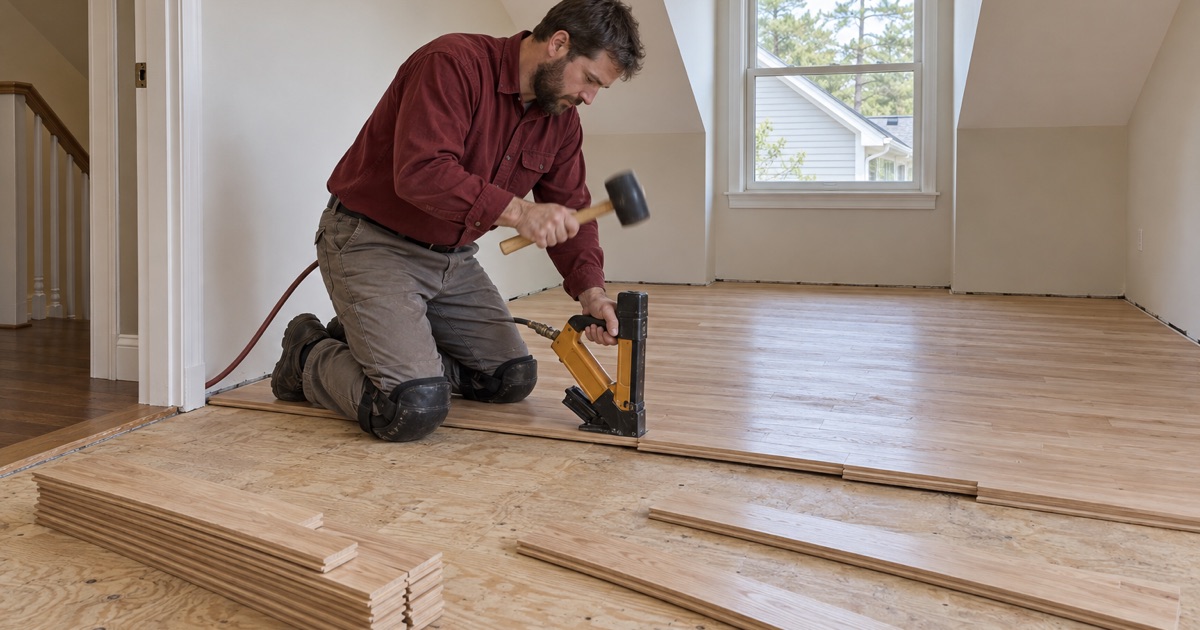
Solid Hardwood for Main and Upper Floors
Solid hardwood is milled from a single piece of wood, usually three-quarter inch thick, with tongue and groove edges. Over a plywood subfloor on a main or upper level, it is the most durable choice, because it can be sanded and refinished many times over the life of the house. It is fastened with flooring cleats or staples driven through the tongue.
Solid wood moves more with humidity than engineered flooring, so it is best kept out of basements, off slabs and away from rooms with persistent moisture. Where it belongs, few floors last longer.
Engineered Hardwood for Slabs and Basements
Engineered hardwood has a real wood wear layer over a layered core that resists swelling and shrinking. That stability makes it the right wood choice below grade and over concrete, where solid boards would cup, and it also suits wide plank designs and radiant heat. It can be glued down, floated or nailed, depending on the product and the subfloor.
We choose the wear layer thickness with you, since a thicker layer allows future sanding and a thinner one limits the floor to recoating.
Species, Widths and Finishes
Red Oak, White Oak, Hickory and Maple
Red oak is the classic American floor, with a warm tone and open grain that hides wear well. White oak has a tighter, cooler grain that takes gray and natural stains beautifully. Hickory is very hard and strongly figured, and maple is hard, smooth and pale, though it can be tricky to stain evenly.
We bring samples to your home so you can see each species in your own light, next to your cabinets and trim, rather than choosing from a small showroom board.
Board Width and Wide Plank Floors
Narrow strip flooring was standard in older homes, while wider boards have become popular in newer ones. Wide plank floors show more of the wood’s grain and have fewer seams, but they move more as humidity changes. For very wide boards, we often recommend engineered construction for stability.
Mixing widths is another option that gives a more rustic, hand-laid look. Whatever width you choose, we match it to the room’s size and the house’s style, since a very wide board can overwhelm a small bedroom while narrow strips can look busy in a large open room.
Prefinished or Site-Finished
Prefinished hardwood arrives with a durable factory finish, so the floor can be used as soon as it is installed, though the boards have small beveled edges. Site-finished hardwood is sanded and finished after installation, giving a flat, seamless surface and a stain color matched to your home. Site finishing also makes blending new floors with existing ones much easier.
Preparing the Subfloor
Flattening and Securing the Subfloor
A hardwood floor can only be as flat as the subfloor beneath it. We remove the old flooring, then check for dips, humps, loose panels and squeaks. High spots are sanded or planed, low spots are filled, and loose panels are screwed to the joists so the new floor stays quiet.
Where we find soft spots or water-damaged subfloor, we replace those sections before going further. Installing over a weak subfloor is how new floors develop squeaks and bounce within a year.
Moisture Readings and Acclimation
We take moisture meter readings on the subfloor and on the delivered flooring. The two need to be within the range the NWFA Installation Guidelines and the manufacturer call for before installation begins. Flooring that is too wet will shrink and gap as it dries, and flooring that is too dry will swell and cup.
Over crawl spaces, we also check that a vapor retarder is in place on the ground, since crawl space humidity is a common source of cupping in Georgia homes.
Expansion Gaps and Transitions
Every wood floor needs room to move, so we leave an expansion gap at the walls, hidden later under baseboard or quarter round. Where the new floor meets tile, carpet or a different height, we install reducers, thresholds and stair nosing so the transitions are safe and clean.
Where hardwood replaces carpet, the new floor often sits at a different height than the tile or vinyl next to it. We measure those changes before ordering, so the right reducer or threshold is on hand and door bottoms are trimmed to clear the new floor.
Layouts and Special Areas
Foyers, Landings and Hallways
Foyers and hallways are where visitors first see the floor, so board direction and layout matter. We plan the starting line so boards run straight through doorways and look deliberate from the entry. On two-story landings, we tie the floor into the stair nosing so the transition looks continuous.
Herringbone and Patterned Floors
Herringbone, chevron and borders add character but require exact layout and more cutting. We establish the centerline and pattern before installing the first piece, so the pattern stays square through the room. These floors take longer to install, and we price them accordingly.
Patterned floors work best in rooms where they can be the focal point, such as an entry, a dining room or a study. A herringbone field bordered by straight boards can also tie a pattern into the surrounding floor without carrying it through the whole house.
- 20+ Years on Wood Floors
- Moisture Read Before Sanding
- Stain Samples on Your Floor