
Roswell Wood Flooring builds and refinishes hardwood stairs in Roswell, GA, serving surrounding cities including Alpharetta, Dunwoody, Milton, Sandy Springs and Johns Creek. In more than 20 years of stair work, we have converted carpeted staircases to hardwood, replaced worn treads and refinished stairs that just needed their shine back, and we quote every staircase tread by tread.
Stairs are one of the most visible parts of a two-story home, and they are also one of the most detailed jobs in flooring. Every tread, riser and nosing is its own piece of work, cut, fitted, sanded or finished individually. That is why refinishing existing stairs and installing new treads are priced as the two different jobs they are, instead of being lumped into a single square-foot number.
Whether you are pulling up worn stair carpet, matching new stairs to a refinished floor or restoring a staircase that has seen decades of traffic, this page walks through the options and how we handle each one.
Converting Carpeted Stairs to Hardwood
What Is Usually Under Stair Carpet
In many homes, the treads under stair carpet were never meant to be seen. Builders often used construction-grade pine or particleboard with a rough bullnose, since the carpet would cover it. Pulling back a corner of the carpet at the top step tells us quickly what you have, and it usually decides the whole approach to the job.
If we find hardwood treads in good shape, refinishing may be possible. More often, the answer is to remove the rough treads or cap over them with new hardwood, then add new risers and nosing. Either way, you get a solid wood staircase instead of an exposed construction surface.
New Treads, Risers and Nosing
A stair conversion typically includes new hardwood stair treads, new risers, and the nosing that forms the rounded front edge of each step. We remove the carpet, carpet pad and tack strip, check that every step is solid and quiet, then cut and fit each tread to its own opening, since stairs are rarely perfectly square.
We glue and fasten each tread so it stays silent for years, and we fit the risers tightly behind them. Where the stairs meet the landing or the floor above, we install a matching nosing so the transition from floor to stair looks continuous and intentional.
Handling Skirt Boards, Balusters and Railings
Stairs are more than treads. Skirt boards run along the wall side, balusters and railings sit on the open side, and each has to be worked around or adjusted when new treads go in. On open stairs, the tread returns on the exposed ends need careful fitting so the end grain is finished cleanly.
Many homeowners take the opportunity to update balusters or paint the railing while the stairs are being redone. We plan the order of work so that painting, railing changes and tread installation do not undo each other, and so nothing needs to be touched twice.
Refinishing Existing Hardwood Stairs
When Refinishing Makes Sense
If your staircase already has hardwood treads that are structurally sound, refinishing can restore them for far less than replacement. Worn finish in the center of each tread, scratches from pets and faded color are all common and fixable. Refinishing also lets you change the stain to match newly refinished floors.
Treads that are cracked, badly split, loose or worn thin at the nosing are better replaced. We look at every tread individually, and it is common to refinish most of a staircase while replacing one or two damaged treads with matching stock.
Why Stairs Are Sanded by Hand
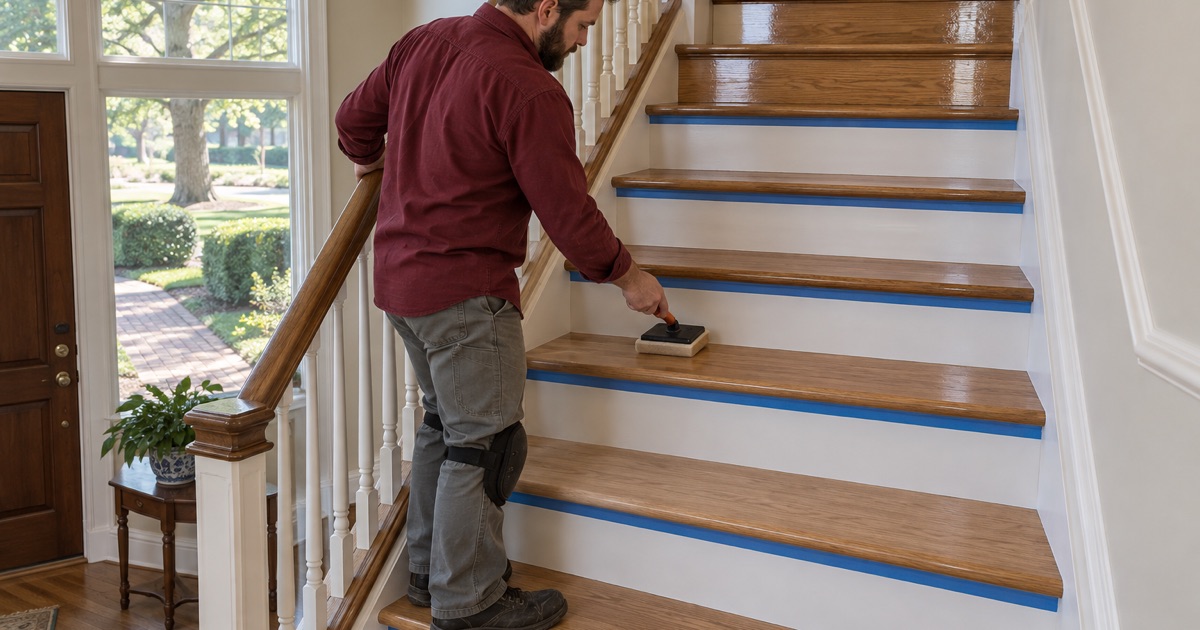
The large drum sanders used on open floors cannot fit on a stair tread. Stairs are sanded with smaller tools and by hand, including the nosing, the corners where tread meets riser and the ends against the skirt board. It is slow, careful work, and it is the main reason stair refinishing is priced per step.
We control dust at each step with extraction and sequence the work so the staircase can be used as long as possible. Where risers are painted, we protect them or plan to repaint them after the treads are finished.
Lead Paint on Older Stair Risers
In homes built before 1978, painted risers, skirt boards and railings may contain lead paint. Sanding them without precautions releases hazardous dust onto the steps that everyone in the house uses. We check the build year and look at painted stair surfaces before any sanding begins.
Where lead may be present, we follow the lead-safe work practices of the EPA RRP Rule, which can mean containing the stairwell, protecting painted parts rather than sanding them, or handling them separately from the treads.
Design Choices for Hardwood Stairs
Matching Stairs to Your Floors
The staircase usually connects two floors, so it should match both. We use the same species as your floors, most often red oak or white oak, and test stain on sample treads beside the existing floor. Stair treads are typically solid hardwood even where the floor is engineered, so we test on both to see how each takes the color.
When the floors are being refinished at the same time, we stain the stairs in the same session for the most consistent color. If the floors are staying as they are, we match the stairs to the existing finish, which may include some aging and amber tone.
Painted Risers or Stained Risers
Painted white risers with stained treads are one of the most popular stair looks, giving a crisp contrast that brightens a stairwell. Stained risers give a warmer, all-wood look that suits traditional homes. Both work well, and the choice often comes down to the trim color and the style of the railing.
We can show you samples of both approaches against your walls. Painted risers also make it easier to touch up scuffs from shoes, which is a practical consideration on a busy family staircase.
Two-Story Foyers and Open Landings
Many homes have a two-story foyer where the stairs rise to an open landing or balcony that overlooks the entry. These landings are visible from below and from every room that opens onto the foyer, so the transition from stair to landing floor matters. We run landing boards and nosing so the pattern lines up cleanly with the stairs.
Where carpet on the landing is being replaced along with the stairs, we tie the new hardwood into the upstairs hallway so the entire route from foyer to bedrooms reads as one continuous floor.
Living With Hardwood Stairs
Finish, Sheen and Grip
Finished hardwood is slicker than carpet, especially for children, older adults and pets. A satin or matte sheen offers more grip than gloss, and some finishes can include a slip-resistant additive. A runner down the center is another option, and we can leave the treads prepared for one.
Stairs also take concentrated wear at the front edge of each tread, where every step lands. A durable finish and a screen and recoat every few years keep that wear from reaching the wood. Felt on the bottom of anything carried up and down, and a mat at the base, help the finish last longer.
Timing the Work
While the finish cures, the stairs are off limits, which can be a challenge in a home with bedrooms upstairs. We plan the schedule with you, often finishing alternate steps or working in stages, so the household still has a way up and down.
When stairs are part of a larger floor project, we usually schedule them after the upstairs floors and before the downstairs finish coats, so nobody has to walk across fresh finish to reach a bedroom. We give you the sequence in writing before starting, including which days each level will be closed.
- 20+ Years on Wood Floors
- Moisture Read Before Sanding
- Stain Samples on Your Floor